
Digital Debt Collections: Building an Omnichannel Strategy That Improves Recovery Rates
Imagine trying to recover payments from a portfolio of one million borrowers.
Some borrowers respond to a simple WhatsApp reminder within minutes. Others ignore every digital notification but answer a phone call. Some promise to pay after speaking to an agent, while others need multiple follow-ups spread across days or even weeks. Yet, many lenders continue to engage every borrower with the same communication strategy, irrespective of their repayment history, preferred channel, or intent.
The result is a familiar challenge:
- Inconsistent borrower engagement
- Overburdened collection teams
- Accounts that continue to roll into deeper delinquency despite increased outreach.
- Rising collection costs
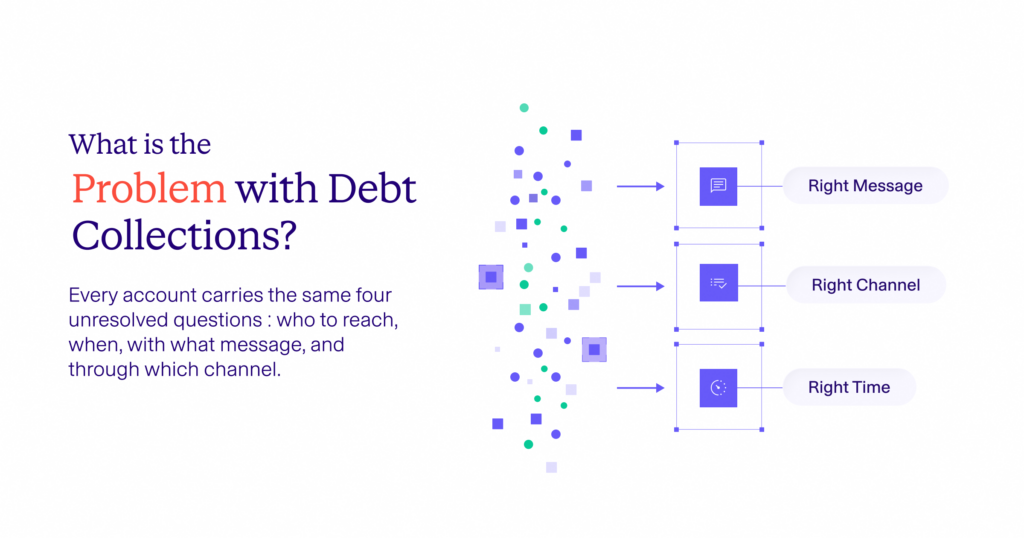
The problem isn’t a lack of communication channels; the problem lies in knowing who to contact, when to contact them, what message to send, and which channel is most likely to drive action.
This is why Digital Debt Collection has become a strategic priority for lenders across banks, NBFCs, fintechs, and housing finance companies right now to understand how Digital Debt Collection can become fruitful. By combining AI, automation, borrower intelligence, and digital communication channels, lenders can create personalised borrower journeys that improve engagement, accelerate recoveries, and reduce operational costs.
In this guide, we’ll explore how combining AI, automation, borrower intelligence, and digital communication channels can help lenders create personalised borrower journeys that improve engagement, accelerate recoveries, and reduce operational costs.
So, let’s start straight with what exactly Digital Debt Collection is.
What Is Digital Debt Collection?
Digital Debt Collection is the process of using digital communication channels, automation, artificial intelligence, and borrower intelligence to engage with borrowers throughout the collections lifecycle.
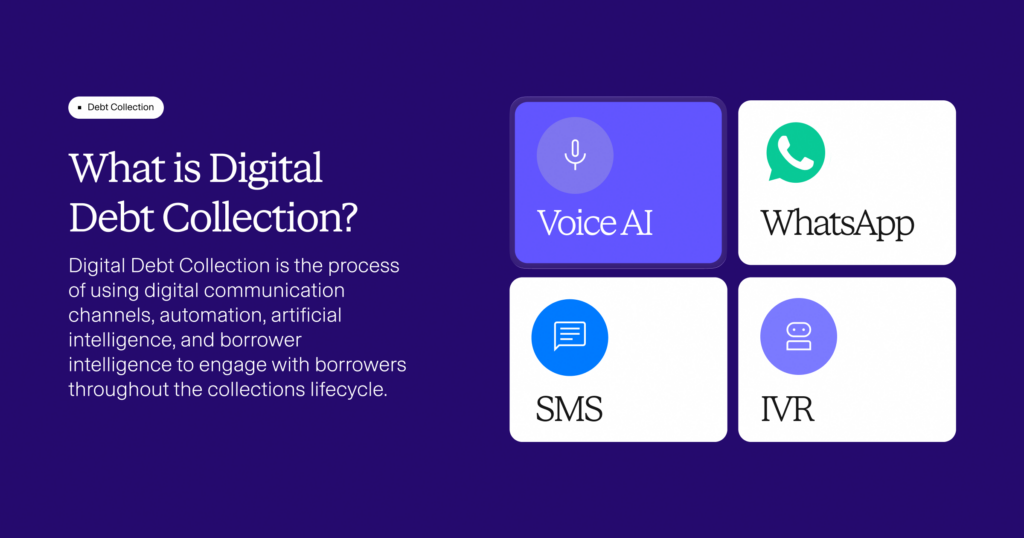
Unlike traditional collections, which primarily depend on manual phone calls and static reminder campaigns, Digital Debt Collection uses multiple connected channels, including WhatsApp, SMS, Voice AI, IVR, Rich Communication Services (RCS), and mobile-first communication to create personalised borrower journeys that adapt in real time.
However, modern Digital Collections are about much more than just digitising reminders.
Modern-age debt collection platforms always try to gather insights into borrower behaviour before deciding how to communicate.
Every borrower enters the collections process with different circumstances. Some borrowers simply need a timely reminder before making payment. Others may require multiple follow-ups, conversations in their preferred language, or support from a collection advisor before they are ready to commit.
Hence, an effective Omnichannel Debt Collection strategy recognises these differences and uses borrower data to determine:
- Which communication channel is most effective.
- When a borrower should be contacted.
- What message should be delivered.
- When communication should shift from automation to a human advisor.
This intelligence is what separates modern Automated Debt Collection Platform like that of DPDzero from conventional campaign management tools.
Instead of sending the same reminder to every borrower, intelligent Automated Debt Collection Technology continuously analyses borrower interactions and adapts outreach based on repayment intent, previous responses, Days Past Due (DPD), portfolio characteristics, and historical engagement patterns.
The result is a collections strategy that feels more relevant for borrowers while becoming significantly more efficient for lenders.
Why Traditional Debt Collection Is No Longer Enough
For decades, collections relied on a straightforward approach: generate an allocation list, assign accounts to collection teams, and contact borrowers until payments were received.
While this model worked when communication channels were limited, today’s lending environment has changed dramatically.
Borrowers interact across multiple digital platforms every day. They expect convenience, personalised communication, and immediate access to information. At the same time, lenders are managing larger portfolios, stricter compliance requirements, and increasing pressure to optimise collection costs.
Traditional collection processes struggle to keep pace with these expectations.
Many lenders continue to manage SMS campaigns separately from WhatsApp, telecalling independently from IVR, and digital reminders without considering previous borrower interactions. This fragmented approach creates several operational challenges:
Generic Communication Creates Lower Engagement
Sending the same reminder to every borrower ignores the reality that repayment behaviour differs across customer segments. A borrower who consistently pays after receiving an SMS should not be treated the same as someone who only responds after speaking to an advisor.
Without borrower segmentation, communication becomes repetitive (and ineffective) rather than relevant. One size fits all approach doesn’t work anymore.
Collection Teams Spend Time on Low-Value Activities
Collection advisors frequently spend significant time making reminder calls that could have been automated. This reduces the time available for negotiation, settlement discussions, and high-value borrower interactions where human expertise creates the greatest impact.
Modern Automated Debt Collection Platform allows routine communication to be handled intelligently while enabling advisors to focus on complex cases.
Multiple Channels Often Operate Independently
Many lenders have adopted digital channels but haven’t connected them. A borrower who is already committed to making a payment through WhatsApp may continue receiving IVR reminders, SMS notifications, and outbound calls because every communication channel functions independently. This not only increases outreach costs but also creates unnecessary borrower fatigue.
True Digital Collections require communication channels to work together in-sync rather than operate in isolation.
Static Campaigns Cannot Adapt to Borrower Behaviour
Traditional campaigns typically follow fixed schedules. If a borrower ignores one communication, the next reminder is often sent without considering why the previous interaction failed. Modern Automated Debt Collection Technology like that of DPDzero continuously learns from borrower behaviour and adjusts communication journeys dynamically. Every interaction becomes an input for the next decision.
This ability to learn and optimise is what makes Digital Debt Collection fundamentally different from traditional collections.
Omnichannel vs Multi-Channel Debt Collection
One of the most common misconceptions in collections is confusing multi-channel communication with Omnichannel Debt Collection.
Although they sound similar, the borrower experience they create is fundamentally different.
A multi-channel strategy simply means using several communication channels. A lender may send WhatsApp reminders, SMS notifications, IVR calls, and outbound calls, but each campaign operates independently.
An Omnichannel Debt Collection strategy, on the other hand, connects every interaction into a single, continuous borrower journey. Every communication builds on the previous one.
If a borrower opens a WhatsApp reminder but doesn’t make a payment, the next interaction may be an SMS containing a payment link. If that remains unanswered, the borrower can automatically move into a Voice AI conversation that captures repayment intent. Complex conversations can then be seamlessly escalated to a human advisor with complete context, eliminating the need for borrowers to repeat information.
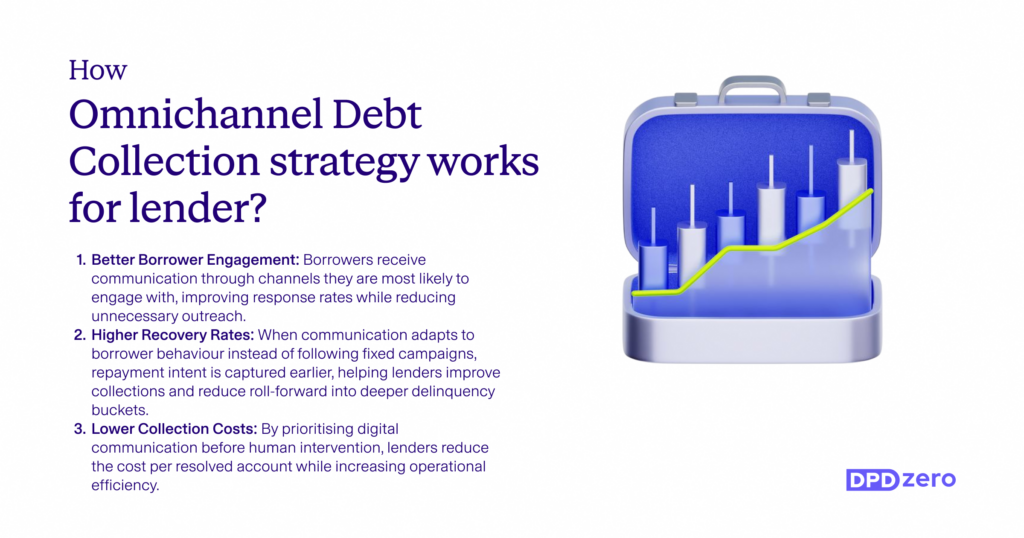
This coordinated approach creates three significant advantages.
- Better Borrower Engagement: Borrowers receive communication through channels they are most likely to engage with, improving response rates while reducing unnecessary outreach.
- Higher Recovery Rates: When communication adapts to borrower behaviour instead of following fixed campaigns, repayment intent is captured earlier, helping lenders improve collections and reduce roll-forward into deeper delinquency buckets.
- Lower Collection Costs: By prioritising digital communication before human intervention, lenders reduce the cost per resolved account while increasing operational efficiency.
[ALT Text for image: Why Omnichannel strategy works for lenders]
Ultimately, Omnichannel Debt Collection isn’t about increasing the number of communication channels. It’s about ensuring every borrower receives the right communication through the right channel at exactly the right moment.
How DPDzero’s Digital Channels Enable Intelligent Debt Recovery
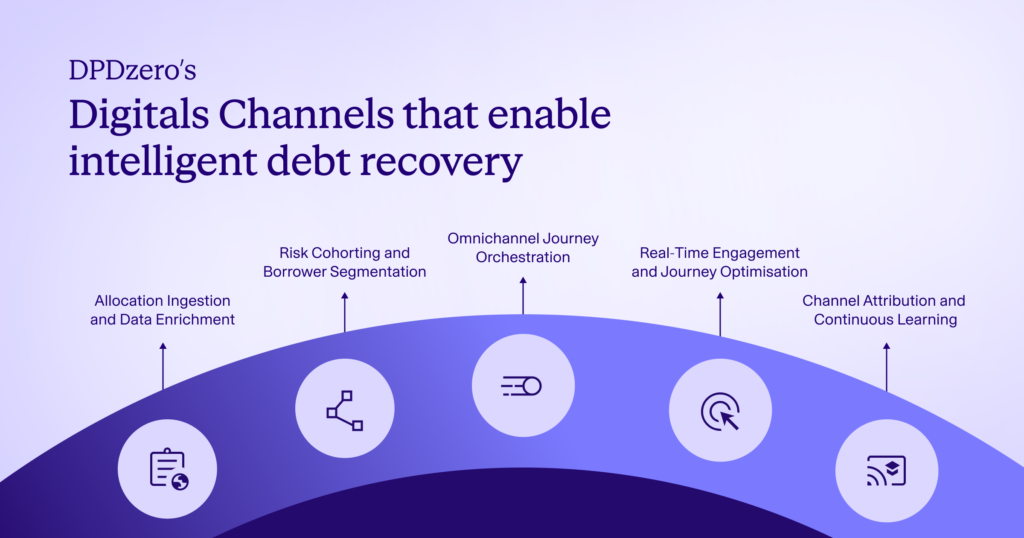
Executing an effective Omnichannel Debt Collection strategy requires more than simply connecting WhatsApp, SMS, IVR, and Voice AI. Behind every successful Digital Debt Collection strategy is a structured workflow that transforms raw borrower data into personalised engagement.
DPDzero’s platform follows five interconnected stages.
Step 1: Allocation Ingestion and Data Enrichment
Every borrower journey begins with lender allocations.
DPDzero’s Allocation Processing and Data Enrichment Engine ingests raw allocation files, validates borrower information, standardises datasets, and enriches every account using internal intelligence and historical collection data.
The platform derives actionable borrower attributes such as repayment patterns, bounce behaviour, previous dispositions, repayment intent, and engagement history.
Instead of static spreadsheets, lenders gain structured, campaign-ready borrower intelligence.
Step 2: Risk Cohorting and Borrower Segmentation
Once borrower data has been enriched, the platform automatically builds intelligent cohorts.
Borrowers are segmented using factors such as:
- Days Past Due (DPD)
- Portfolio Outstanding (POS)
- Geography
- Repayment history
- Historical responsiveness
- Previous collection outcomes
- Behavioural and intent signals
Each segment receives a collection strategy tailored to its risk profile, enabling lenders to move beyond one-size-fits-all campaigns and improve engagement across every stage of delinquency.
Step 3: Omnichannel Journey Orchestration
The next stage is execution.
DPDzero activates personalised borrower journeys across WhatsApp, SMS, RCS, IVR, and Voice AI through a single orchestration engine.
Communication can begin before the due date, continue through early delinquency, and automatically adapt based on borrower responses.
Instead of running isolated campaigns, lenders create connected borrower journeys and experience where every communication builds upon the previous interaction.
This is the foundation of intelligent Omnichannel Debt Collection.
Step 4: Real-Time Engagement and Journey Optimisation
Every borrower interaction creates valuable behavioural intelligence.
DPDzero continuously monitors:
- Message opens
- Payment link clicks
- Responses
- Promise-to-Pay (PTP) commitments
- Payment completions
- Channel activity
Using these signals, the platform automatically refines messaging, communication timing, follow-up sequences, and channel selection.
Rather than waiting for future campaign cycles, Automated Debt Collection Platform optimises borrower journeys continuously, helping lenders improve engagement while reducing communication fatigue.
Step 5: Channel Attribution and Continuous Learning
The final stage closes the feedback loop.
DPDzero evaluates the effectiveness of every communication channel by measuring borrower engagement, repayments, conversion rates, and outreach costs.
For example, if WhatsApp consistently generates stronger borrower engagement for a particular segment or allocation, future campaigns automatically prioritise it. Similarly, if Voice AI proves more effective for specific delinquency buckets, the platform adjusts future collection strategies accordingly.
Over time, this continuous learning enables lenders to optimise both operational efficiency and recovery performance on consecutive collection cycles.
Choosing the Right Digital Channels for Every Borrower
One of the biggest myths surrounding Digital Debt Collection is that adding more communication channels automatically leads to better recovery rates.
It doesn’t.
Successful Digital Collections are built on selecting the right channel for the right borrower at the right moment. Every borrower has different communication preferences, repayment behaviours, and levels of engagement. Some respond immediately to a WhatsApp reminder, while others only act after a conversation. Others may simply require a payment link delivered through SMS.
An effective Omnichannel Debt Collection strategy understands these differences and orchestrates communication accordingly.
Rather than operating WhatsApp, SMS, IVR, RCS, and Voice AI as separate campaigns, DPDzero’s Automated Debt Collection Platform brings every interaction together into a single borrower journey. Every response, missed interaction, payment, and Promise-to-Pay (PTP) becomes an input that determines the next best action.
Let’s look at the role each channel plays in an intelligent Digital Debt Collection strategy.
WhatsApp: Driving High-Engagement Digital Collections
For many borrowers, WhatsApp has become the preferred channel for day-to-day communication, making it one of the most effective platforms for Digital Debt Collection.
With an upwards of 92% read rate, WhatsApp provides significantly higher visibility than many traditional communication channels. More importantly, it allows lenders to move beyond simple reminder messages by enabling rich, interactive experiences opening a gateway to two-way communication for the borrower.
Through DPDzero’s Automated Debt Collection Platform, WhatsApp can be used to:
- Send personalised payment reminders.
- Share secure payment links.
- Deliver due-date and overdue notifications.
- Trigger follow-up messages based on borrower behaviour.
- Guide borrowers through self-service repayment journeys.
Because communication is driven by AI-led borrower segmentation, every message is contextual rather than generic. Borrowers receive reminders based on their DPD bucket, repayment behaviour, geography, outstanding amount, and previous interactions, creating a more personalised Digital Collections experience.
SMS: Ensuring Universal Reach Across Every Portfolio
While digital messaging platforms continue to grow, SMS remains one of the most dependable communication channels in Omnichannel Debt Collection.
Its biggest advantage is reach.
Unlike app-based messaging, SMS reaches virtually every mobile device, regardless of operating system, internet connectivity, or smartphone availability. This makes it an essential component of any automated debt collection technology stack.
DPDzero’s platform uses SMS to deliver:
- Due date reminders.
- Payment confirmations.
- Secure payment URLs.
- Critical account notifications.
- Time-sensitive collection updates.
With 100% device reach, SMS complements WhatsApp and other digital channels, ensuring that no borrower is excluded from the collections journey.
RCS: Creating Richer Borrower Experiences
As Android adoption continues to grow, Rich Communication Services (RCS) is redefining how businesses engage customers. Unlike traditional SMS, RCS enables verified business messaging, branded conversations, interactive buttons, multimedia content, and richer payment experiences.
DPDzero supports native Android experiences through RCS, allowing lenders to deliver modern borrower journeys without requiring users to download additional applications.
Within an Omnichannel Debt Collection strategy, RCS bridges the gap between conventional SMS and app-based messaging by delivering highly interactive repayment experiences directly inside the native messaging application.
IVR: Scaling Personalised Outreach Across Languages
Collections often require reaching hundreds of thousands of borrowers within a limited time window. Interactive Voice Response (IVR) enables lenders to scale this outreach while maintaining consistency across every interaction.
Through DPDzero’s Digital Channels, IVR supports communication in 8+ Indian languages, helping borrowers engage comfortably in their preferred language while ensuring compliance with lender-approved messaging.
IVR campaigns can be used for:
- Payment reminders.
- Upcoming due-date notifications.
- Overdue alerts.
- Campaign announcements.
- Automated borrower confirmations.
When integrated with other digital channels, IVR becomes another intelligent touchpoint within a broader Digital Debt Collection journey rather than a standalone campaign.
When Messaging Isn’t Enough, Voice AI Takes Over
Digital channels like WhatsApp, SMS, RCS, and IVR are highly effective at delivering reminders and encouraging repayments.
However, not every borrower responds to a notification.
Some borrowers have questions about their dues. Others need reassurance before committing to repayment. Some raise objections, request additional time, or prefer speaking to someone instead of reading a message.
This is where conversational AI transforms Digital Debt Collection.
Rather than functioning as another outbound calling solution, DPDzero’s Voice AI acts as the conversational layer within its? Automated Debt Collection Platform?, enabling lenders to conduct thousands of intelligent borrower conversations every day.
The platform captures Promise-to-Pay (PTP) commitments, shares payment links during conversations, executes intelligent follow-ups, handles routine objections, and seamlessly switches between multiple Indian languages. Whenever a conversation requires negotiation, empathy, or human judgement, Voice AI automatically transfers the interaction to a collection advisor with complete conversational context.
This ensures AI handles repetitive, high-volume interactions while advisors focus on cases where they can create the greatest impact. Importantly, Voice AI adapts its role based on where the borrower is in the collections lifecycle.
How Lenders Are Benefitting Using DPDzero’s Fullstack Collections Platform – A Case Study
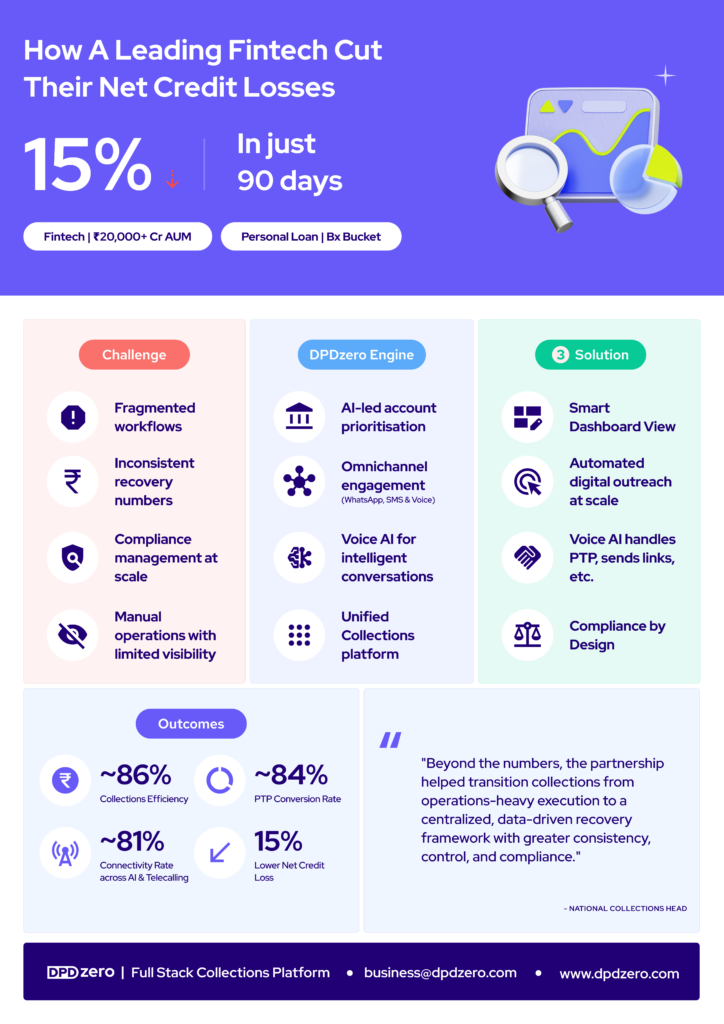
Despite having a growing collections team, a fintech lender with ₹20,000+ Cr AUM struggled with fragmented workflows and inconsistent recovery performance. Compliance became increasingly difficult to manage at scale, while manual operations limited visibility into borrower engagement and collections performance.
The key challenges included:
- Fragmented collections workflows
- Inconsistent recovery outcomes
- Compliance management at scale
- Manual operations with limited visibility
The DPDzero Approach
To address these challenges, DPDzero implemented an AI-driven, digital-first collections strategy that unified the lender’s entire collections process.
The solution included:
- AI-led account prioritisation
- Omnichannel engagement across WhatsApp, SMS, and Voice
- Voice AI for intelligent borrower conversations
- A unified collections platform with real-time visibility
The Solution in Action
Instead of relying on manual interventions, the collections team leveraged automation throughout the recovery journey.
Key capabilities included:
- A smart collections dashboard for complete portfolio visibility
- Automated digital outreach at scale
- Voice AI to capture Promise-to-Pay (PTP) commitments and share payment links
- Compliance-by-design workflows to ensure every interaction met regulatory requirements
The Results
Within just 90 days, the lender achieved measurable business outcomes:
- 86% Collection Efficiency
- 84% Promise-to-Pay (PTP) Conversion Rate
- 81% Connectivity Rate across AI and Telecalling
- 15% Reduction in Net Credit Loss
These improvements weren’t driven by increasing collection effort – they were driven by making collections more intelligent, automated, and data-driven.
The Future of Automated Debt Collection Technology
The future of Digital Debt Collection will not be defined by adding more communication channels; it will be defined by making every interaction more intelligent.
As lending portfolios continue to expand, borrowers will increasingly expect personalised, digital-first experiences that mirror the convenience they receive from other financial services.
Future-ready Automated Debt Collection Technology will rely on:
- AI-driven borrower intelligence that predicts repayment intent before communication begins.
- Hyper-personalised borrower journeys that adapt continuously based on behaviour.
- Greater use of conversational AI through Voice AI and multilingual engagement.
- Real-time channel optimisation using behavioural analytics.
- Compliance-first automation aligned with evolving regulatory requirements.
- Seamless collaboration between AI systems and human collection advisors.
Rather than replacing collection teams, AI will continue to augment them, handling high-volume, repetitive interactions while enabling advisors to focus on empathy, negotiation, and resolution.
Meeting these demands requires more than adding new communication channels.
It requires an intelligent Digital Debt Collection strategy powered by borrower insights, AI, automation, and connected communication journeys.
By combining AI-led segmentation, Omnichannel Debt Collection, Digital Channels, and Voice AI, lenders can move beyond fragmented campaigns and build scalable, data-driven collection operations that improve recoveries while reducing operational costs.
The result is a collections ecosystem that is more efficient for lenders, more personalised for borrowers, and better equipped to adapt as repayment behaviour continues to evolve.
If you’re looking to modernise your collections strategy, improve borrower engagement, and drive higher recoveries through intelligent automation, DPDzero can help you build the next generation of Digital Debt Collection.
For a quick portfolio review with DPDzero experts, please book a demo with us by clicking here.
Frequently Asked Questions (FAQs)
1. What is Digital Debt Collection?
Digital Debt Collection is the process of using digital communication channels, AI, automation, and borrower intelligence to engage borrowers, improve recovery rates, and optimise collections through personalised communication.
2. Why is Omnichannel Debt Collection important?
Omnichannel Debt Collection connects every borrower interaction into a single communication journey. Instead of running isolated campaigns, lenders can adapt messaging based on borrower behaviour, improving engagement, reducing communication costs, and increasing recoveries.
3. How does Voice AI improve Digital Collections?
Voice AI enables lenders to conduct thousands of AI-powered borrower conversations simultaneously in a human-nuanced manner. It captures Promise-to-Pay commitments, handles objections, shares payment links, and seamlessly escalates complex conversations to human advisors. Voice AI is currently available in more than 12+ native Indian languages. Voice AI can be used for early as well as late delinquencies.
4. How do Digital Channels improve recovery rates?
Digital Channels improve recovery rates by combining borrower segmentation, omnichannel communication, AI-driven optimisation, and real-time behavioural insights. This ensures borrowers receive the right communication through the right channel at the right time, leading to higher engagement and faster recoveries.
5. Difference between Multi-Channel and Omnichannel Debt Collection?
Multi-channel debt collection uses multiple independent channels like SMS, WhatsApp, IVR and calls, often with disconnected borrower journeys. Omnichannel debt collection unifies these channels through a single orchestration engine, delivering personalised, coordinated outreach based on borrower behaviour and real-time outcomes.